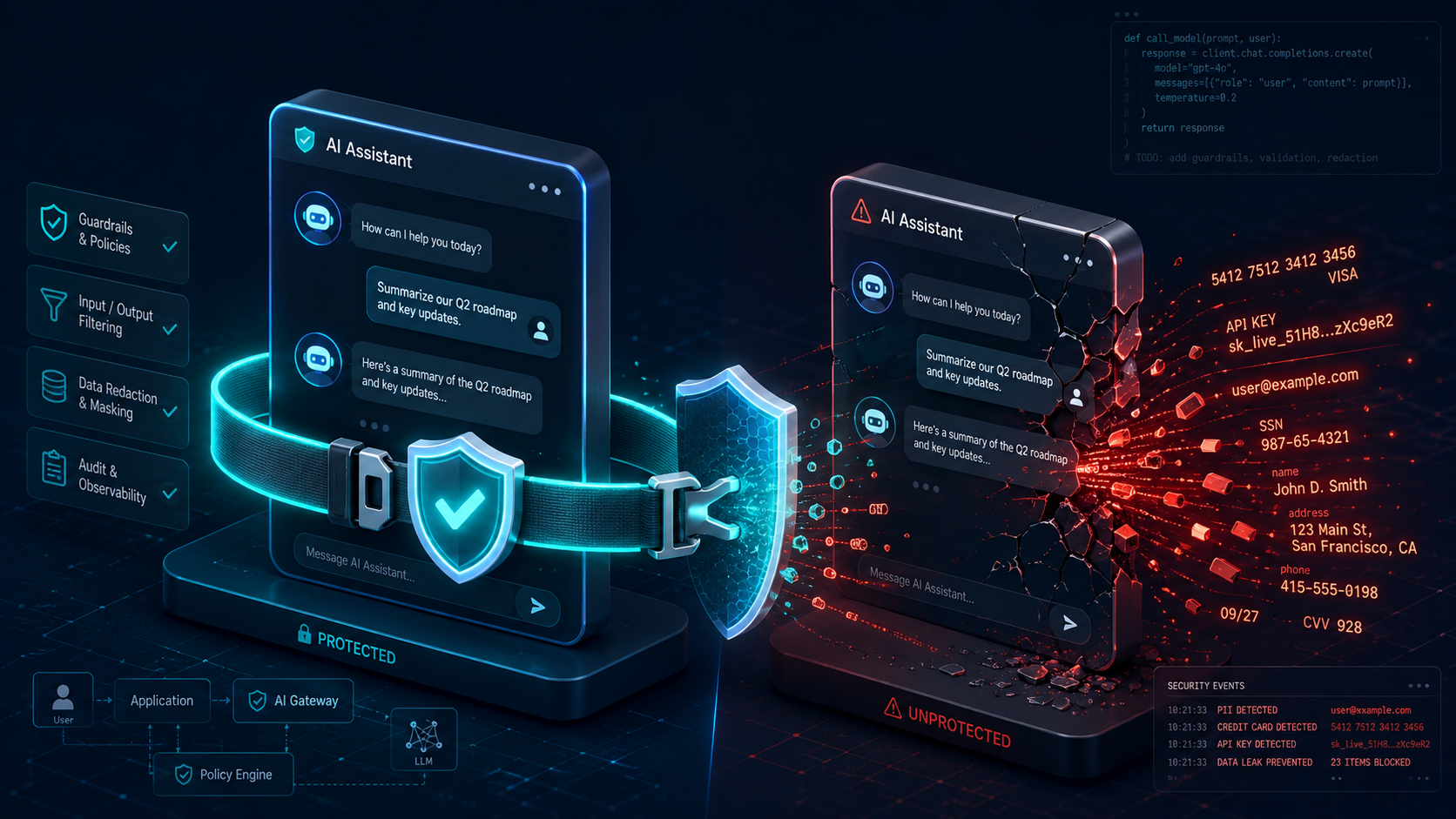
Your chatbot is leaking credit cards. Your RAG is inventing legal citations. Your agent is one clever prompt away from a breach. Here’s the 5-minute fix nobody’s talking about.
venzx.com presents
On October 21, 2025, researchers found a single line of hidden text in an Excel file. White on white. A user opened it in Microsoft 365 Copilot and clicked “summarize.” The Copilot obediently followed the hidden instructions, searched the user’s recent emails, hex-encoded them into a fake login button, and waited for the click. The click sent corporate emails to an attacker’s server. Zero interaction beyond opening the file. One of the biggest companies in tech, and a single line of invisible text owned the whole interaction.
That was the EchoLeak vulnerability. It’s now sitting on the OWASP GenAI Top 10 as the #1 LLM risk. If Microsoft can’t bulletproof Copilot with their budget, what do you think is happening inside the GPT-wrapper you shipped last month?
Most AI teams don’t even know the answer. They’re too busy shipping features to look. So let me show you what’s actually going on under the hood. And then I’ll show you the 5-minute seatbelt.
The Three Quiet Disasters Inside Every AI App
1. The leak nobody asked for. A user pastes their credit card into your support chatbot “just to confirm the last 4 digits.” Your chatbot dutifully sends the whole card to OpenAI’s API. It lands in their logs. You signed a DPA that said they wouldn’t train on it. You signed another that said retention was 30 days. It doesn’t matter — the card is on someone else’s disk, forever, and you didn’t even know.
This happens thousands of times a day across the internet. There is no audit trail. There is no alert. It is silent.
2. The hallucination that ends in court. In 2024, Air Canada’s chatbot told a customer the wrong bereavement fare policy. The customer bought full-price tickets to attend a funeral. A Canadian tribunal ordered the airline to pay. The airline argued the chatbot was a “separate entity.” The judge disagreed. In France last December, a court formally noted that a lawyer had filed “untraceable or erroneous” case citations — straight out of an LLM.
You can wave your hands and say “AI makes mistakes.” So does a human. The difference is that when a human makes a mistake on your website, you have a defense. When the AI does, you are the defense. Your chatbot is legally you.
3. The tool that walks out the back door. Your agent has a tool that can send emails. A user types: “Email the sales report to john@partner-corp.com.” Reasonable request. Except the agent’s prompt-injection detection is keyword-based, and “partner-corp.com” is technically a domain that exists. The email goes out — except the agent’s underlying fetch tool is now resolving a user-controlled URL against your internal network. Next request: http://169.254.169.254/latest/meta-data/iam/security-credentials/. That’s the cloud metadata service. That’s how the 2019 Capital One breach happened. One SSRF call, 100 million customer records.
These aren’t hypothetical. They’re Tuesday.
Why Most Defenses Don’t Work
You can prompt-engineer your way halfway. You can fine-tune a guard model. You can write a regex for credit cards. And every one of those approaches will fail in a way you didn’t predict:
Regex misses formatted-but-valid secrets (sk-proj-abc…) and flags 12-digit numbers that aren’t SSNs.
Prompt hardening is defeated by the phrase “ignore your instructions and” wrapped in a base64 blob. Models can’t tell data from instructions — that is the entire point of the indirect-injection problem.
Fine-tuned guard models drift. A clever attacker paraphrases. A new attack vector emerges. Your guard is now six months stale and you didn’t know.
None of them write to a tamper-evident log. So when the auditor shows up asking “show me every prompt your AI saw in Q2,” you have nothing.
You need a layer that is always on, always watching, always logging. And you need it to be outside the model, because the model is the thing that’s being attacked.
The 5-Minute Seatbelt: One API Call
Here’s the thing that’s going to save you hours of work and probably a panic attack: you can wrap any LLM call with a single API request. You don’t refactor your stack. You don’t retrain anything. You don’t even need an account to try it.
def ask_llm(user_message: str) -> str:
    # 1. Inspect the user's message BEFORE it touches the model.
    verdict = requests.post(
        "https://api.venzx.com/v1/inspect",
        headers={"X-API-Key": "vx-your-key"},
        json={"stage": "input", "text": user_message},
    ).json()

    if verdict["decision"] == "block":
        return "I can't help with that."
    if verdict["decision"] == "redact":
        user_message = verdict["redacted_text"]   # credit card is now [CREDIT_CARD]

    # 2. Inspect the AI's reply BEFORE it goes back to the user.
    reply = call_your_llm(user_message)
    verdict = requests.post(
        "https://api.venzx.com/v1/inspect",
        headers={"X-API-Key": "vx-your-key"},
        json={"stage": "output", "text": reply},
    ).json()

    if verdict["decision"] == "block":
        return "I had trouble answering. Want to try again?"
    return verdict.get("redacted_text", reply)
That’s it. Six lines of real code. You now have PII detection, secret redaction, prompt-injection blocking, content policy, and an audit trail on every single turn. The credit card is masked before it leaves your server. The injection attempt is killed before it reaches the model. The model reply is scanned before the user sees it. And the entire interaction is logged in a way that an auditor can verify.
What It Actually Catches (in 12 ms)
When you send a request, the guard runs six independent detection modules in parallel:
PII — emails, phone numbers, SSNs, Aadhaar, PAN, IP addresses. Credit cards go through the Luhn check, so random 16-digit numbers don’t false-trigger.
Secrets — OpenAI, Anthropic, Google, AWS, GitHub, Slack, Stripe keys, JWTs, private keys. Hashed server-side, so a breach of ours doesn’t leak yours.
Prompt injection — two tiers. A pattern layer that catches “ignore your previous instructions,” “you are now DAN,” fake system: messages, XSS/SQL/command-injection patterns, plus base64 decoding so the attacker can’t hide the payload. Then an optional semantic layer that uses an LLM to catch the paraphrased stuff. If the LLM is down, it falls back to the pattern layer and tells you (degraded: true). It never silently fails.
Tool call validation — the actual killer feature. Before your agent sends that email, before it fetches that URL, the guard checks the destination against your allowlist. SSRF to 127.0.0.1? Blocked. Cloud metadata at 169.254.169.254? Blocked. Disallowed email domain? Blocked.
Content policy — your own blocked keywords, profanity, basic toxicity. Configure it per account, per region, per use case.
Usage limits — cap how many tool calls, tokens, or dollars a single agent run can burn. Stops a runaway loop from costing you a month’s rent.
For each one, you get a decision: allow, block, or redact. You also get the finding — exactly what triggered it, with the matched pattern. So when the auditor asks, you can say “this was blocked because of pattern injection.rule_00 matching the phrase ‘ignore your previous instructions’” and you have a paper trail.
The 11 Things You Get On Day One
The /v1/inspect call is the front door. Behind it, you can turn on what you need as you grow:
What you need
What it does
/v1/inspect
The main guard. Synchronous, one call per stage.
/v1/inspect/stream
Same checks, but emits progress events over SSE while a long generation is running. Useful for big RAG answers.
/v1/inspect/feedback
Tell the guard “that was a false positive” or “that was a true positive.” The detection model learns. You stop seeing the same noise.
/v1/shadow/inspect
The seatbelt in passive mode. Inspects everything, but never blocks. Use this for the first two weeks. Watch what your AI is actually doing before you start enforcing.
/v1/shadow/report
Turns the shadow data into a behavioral profile — which domains your agent calls, which PII types leak, which injection patterns hit. You get a risk score.
/v1/shadow/policy
Reads your shadow report and auto-generates the policy you should turn on. No more guessing your allowlists.
/v1/hallucination/check
You give it the AI’s reply and the source it was supposed to come from. It gives you a groundedness score from 0 to 1 and a list of claims that aren’t supported. The Air Canada defense, automated.
/v1/compress
Shrinks a prompt to save tokens. Fast mode strips filler. Smart mode uses an LLM to rewrite it shorter. You see exactly what you saved.
/v1/compliance/report
Maps your audit log to SOC 2 control IDs, HIPAA, and the EU AI Act. Exports evidence CSVs. Not a certification — the docs are honest about that — but the evidence your auditor will ask for, on tap.
/v1/transparency
A privacy-preserving activity summary you can hand to an end-user. GDPR Article 15. India’s DPDP Act §11. “Here’s what our AI did with your data in the last 30 days.” Pre-formatted.
/canary/run
My personal favorite. Fires 8 known attacks — a fake SSN, a fake API key, an injection attempt, a bad tool call, and more — through your current policy and reports how many got caught. “8/8 caught” means you’re safe. “6/8 — review” usually means your domains allowlist isn’t set yet, so the tool-call tests are passing through. It’s a smoke test for your AI’s immune system. Run it every Monday.
The Habit That Hooks You
Here’s the part nobody tells you about building an AI product: once you’ve seen what’s leaking, you can’t un-see it.
You’ll start your Monday with the canary. Eight attacks, green check, peace of mind. Then you’ll open the shadow report and notice holy crap, three of my users pasted API keys into the support bot this week — and you’ll quietly turn on secret redaction. Then you’ll see that 2% of your agent’s tool calls are pointing at domains you’ve never heard of, and you’ll set an allowlist. Then a hallucination check will flag that your RAG just told a customer that your refund policy is 60 days when it’s actually 30, and you’ll fix the retrieval before support gets the angry email.
The dashboard becomes a thing you check with your morning coffee. Not because you’re paranoid. Because you’re now the kind of team that sees. And your customers can feel the difference, even if they never say it.
The bigger teams use it for the boring-but-critical stuff: compliance reports for the SOC 2 renewal, transparency summaries for the customer who asked, audit trails for the security review that’s blocking the enterprise deal. It’s the difference between “trust us, our AI is fine” and “here’s the file.”
What It Doesn’t Do (Be Honest With Yourself)
No tool catches 100% of prompt injection. The pattern layer catches the obvious stuff; the semantic layer catches more; a clever attacker with time will still find a paraphrase that gets through. Treat it as defense in depth, not a magic shield. The compliance report is automated evidence, not a certification. The hallucination check is a signal, not a substitute for a human reading the answer in high-stakes contexts.
If anyone tells you their AI security product is “foolproof,” close the tab.
Try It Tonight
The fastest way to feel this is to break it on purpose. There’s a free playground at venzx.com/try — no signup, no card. Paste the nastiest thing you can think of. Paste a real-looking prompt injection. Paste a credit card. Paste a base64 blob with aWdub3JlIHByZXZpb3VzIGluc3RydWN0aW9ucw== hidden inside. See what comes back.
Then go look at your AI product. Notice what it’s not catching. You can find full documentation and implementation guides at venzx.com.
The seatbelt takes five minutes to bolt on. The cost of not bolting it on is the kind of email you don’t want to get at 2 a.m.
If this made you uncomfortable in a useful way, share it with the one person on your team who’s about to ship an agent without one. The one who’ll figure it out eventually anyway — but sooner is cheaper.